.png)
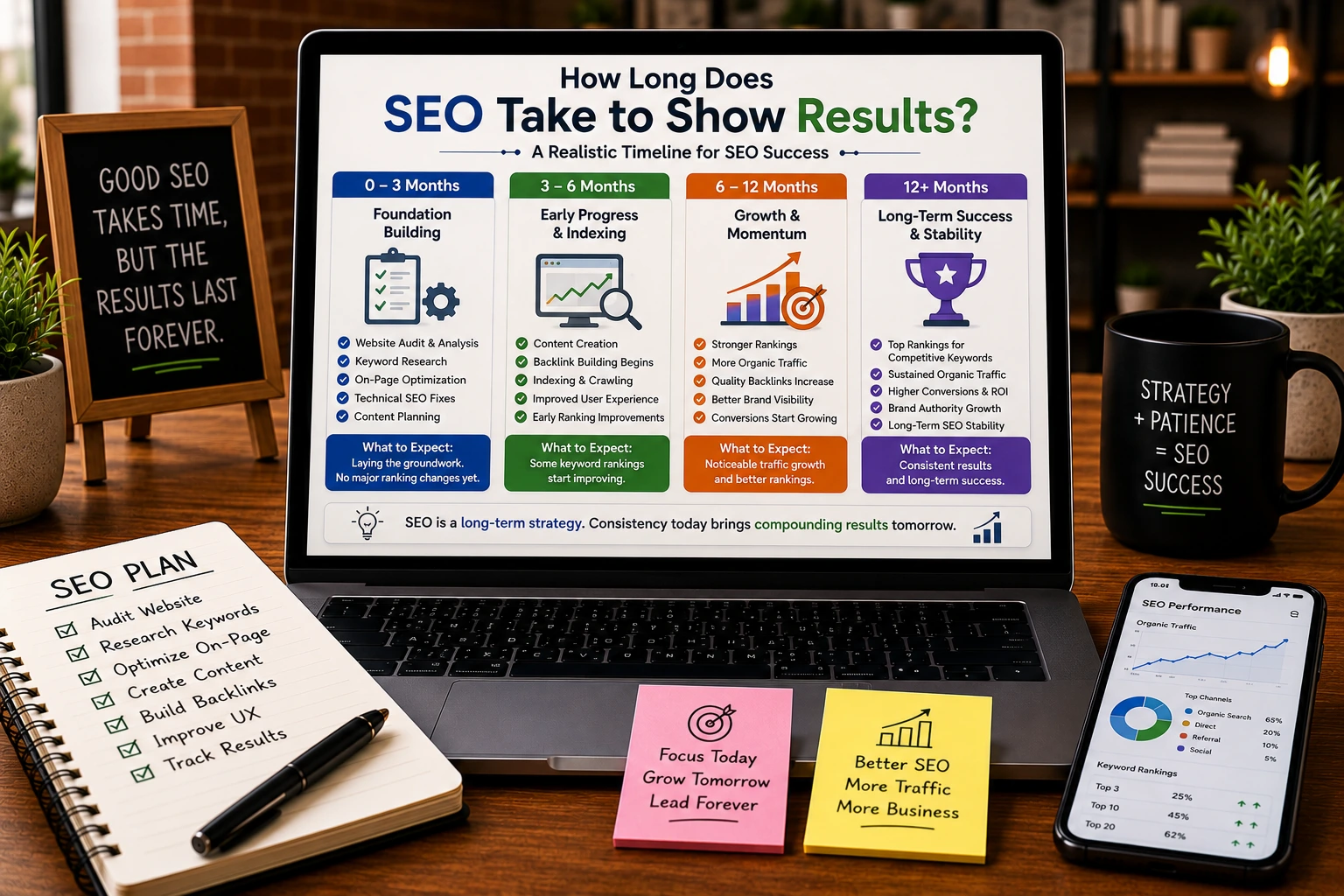
One of the most common questions businesses ask before investing in SEO is: how long does SEO take to show results?
The honest answer is that SEO is a long-term marketing strategy, not an overnight solution. Unlike paid advertising, where traffic can begin immediately, SEO requires time for search engines to crawl, evaluate, and trust your website before significant ranking improvements occur.
While every website is different, most businesses begin seeing measurable progress within 3 to 6 months, with stronger results often appearing between 6 and 12 months.
Understanding the SEO process and setting realistic expectations can help businesses stay committed to strategies that deliver sustainable growth over time.
If you’re new to search optimization, our complete guide on SEO explains how SEO works and why long-term consistency is essential for success.
Quick Answer: How Long Does SEO Take?
Typical SEO Optimization Timeline
| Timeframe | What Usually Happens |
| Month 1 | Audit, research, technical fixes |
| Month 2 | On-page optimization and content planning |
| Month 3 | Initial ranking improvements |
| Month 4-6 | Traffic growth and keyword movement |
| Month 6-12 | Stronger rankings and lead generation |
| 12+ Months | Authority growth and long-term scaling |
While some websites see results sooner, most successful SEO campaigns require patience and consistent effort.
Why SEO Takes Time
Many business owners wonder: why does SEO take so long?
The answer lies in how search engines evaluate websites.
Google doesn’t simply rank pages because they contain keywords. Instead, it evaluates hundreds of factors including:
- Content quality
- Website authority
- User experience
- Backlinks
- Technical performance
- Search intent
- Competitor strength
Building trust with search engines takes time, especially for newer websites.
Factors That Affect SEO Timelines
Not every website follows the same timeline.
Several factors influence how quickly SEO results appear.
1. Website Age and Authority
Established websites often see results faster because search engines already trust them.
Older domains may have:
- Existing backlinks
- Indexed content
- Domain authority
- Historical performance data
New websites must build these signals from scratch.
2. Competition Level
The more competitive your industry, the longer SEO typically takes.
Example
Ranking for:
“best pizza near me”
is often easier than ranking for:
“personal injury lawyer”
Highly competitive industries require:
- More content
- Stronger backlinks
- Better optimization
- Greater authority
3. Technical SEO Health
Technical issues can slow SEO progress significantly.
Common problems include:
- Slow loading pages
- Crawl errors
- Broken links
- Poor site architecture
- Indexing issues
Many businesses discover these issues during a technical audit. Our guide on technical SEO explains many of the technical factors that influence rankings.
4. Content Quality
Content remains one of Google’s strongest ranking signals.
Websites that consistently publish:
- Helpful content
- Original insights
- Topic clusters
- Comprehensive resources
often see stronger long-term growth.
Thin or outdated content can delay results.
5. Backlink Profile
Backlinks act as trust signals.
Websites with strong backlink profiles generally rank faster than websites with little authority.
Building quality backlinks naturally takes time and consistent effort.
A Realistic SEO Optimization Timeline
Let’s look at what businesses can realistically expect during different stages of an SEO campaign.
Month 1: Research and Audit Phase
The first month typically focuses on preparation.
Activities often include:
- Website audit
- Keyword research
- Competitor analysis
- Technical reviews
- Content gap analysis
Most businesses see little to no ranking improvement during this stage because foundational work is being completed.
Month 2: Optimization Phase
Once research is complete, implementation begins.
Common tasks include:
- Title tag optimization
- Meta description updates
- Internal linking improvements
- Technical fixes
- Content optimization
Businesses focused on local visibility may also begin implementing recommendations from our local SEO for small business guide.
Some keyword movement may begin during this period.
Months 3-4: Early SEO Signals
This is often when websites begin seeing the first signs of progress.
Examples include:
- More keyword rankings
- Increased impressions
- Improved indexing
- Better crawl activity
Google begins evaluating optimization efforts more actively.
However, major traffic growth may still be limited.
Months 4-6: Traffic Growth Begins
For many websites, this is when SEO momentum starts becoming visible.
You may begin noticing:
- Higher rankings
- More organic traffic
- Increased lead generation
- Improved click-through rates
Businesses that consistently publish quality content often see stronger growth during this phase.
Months 6-12: Significant Growth Phase
This is where many successful SEO campaigns begin generating meaningful business results.
Common outcomes include:
- First-page rankings
- Increased conversions
- Higher authority
- More backlinks
- Stronger organic visibility
The cumulative impact of technical, content, and authority improvements becomes more noticeable.
12+ Months: Long-Term SEO Growth
After a year of consistent SEO efforts, websites often experience:
- Stable traffic growth
- Increased brand visibility
- Improved domain authority
- Higher conversion potential
This is where SEO often becomes one of the highest-ROI marketing channels available.
Why Some Websites See Results Faster
Certain websites may see improvements more quickly because they already have:
- Existing authority
- Strong backlink profiles
- Technical optimization
- Content foundations
In these situations, even small improvements can produce noticeable gains.
Common Reasons SEO Results Are Delayed
Many businesses become frustrated because expectations are unrealistic.
Common reasons SEO progress slows include:
Inconsistent Content Publishing
Publishing one or two articles rarely produces significant results.
Technical Problems
Technical issues can prevent search engines from properly understanding your website.
Weak Keyword Targeting
Choosing highly competitive keywords often delays rankings.
Lack of Backlinks
Authority building takes time and effort.
Constant Website Changes
Frequent redesigns or structural changes can disrupt SEO progress.
How to Speed Up SEO Results
While SEO cannot be rushed, certain actions can improve efficiency.
Focus on Technical Health
Strong technical foundations support faster growth.
SEO professionals often use strategies discussed in mastering google search operators to identify indexing and crawl issues more effectively.
Create High-Quality Content
Content should focus on:
- Search intent
- User value
- Topical depth
- Problem solving
Improve Internal Linking
Strong internal linking helps distribute authority across important pages.
Target Realistic Keywords
Balancing competitive and attainable keywords often produces faster results.
Build Quality Backlinks
Authority remains one of the strongest ranking signals.
What SEO Success Actually Looks Like
Many businesses define success incorrectly.
Success is not only:
- Ranking #1
- Viral traffic spikes
Success often includes:
- Increased visibility
- More qualified traffic
- Better lead generation
- Higher conversions
- Improved brand authority
SEO should be measured by business outcomes, not rankings alone.
How SEO Differs From Paid Advertising
Paid advertising can generate traffic immediately.
SEO works differently.
Paid Advertising
- Immediate visibility
- Ongoing costs
- Stops when spending stops
SEO
- Slower results
- Long-term growth
- Compounding returns
Businesses investing in SEO services in the USA often view SEO as a long-term asset rather than a short-term tactic.
How Design Vertices Helps Businesses Achieve SEO Growth
At Design Vertices, we help businesses build sustainable SEO strategies focused on long-term growth.
Our approach includes:
- Technical SEO audits
- Content optimization
- Keyword research
- On-page SEO
- Local SEO
- Authority building
Rather than chasing quick wins, we focus on creating scalable strategies that continue generating results long after implementation.
Final Thoughts
So, How Long Does SEO Take to Show Results? For most businesses, initial improvements appear within 3 to 6 months, while stronger growth typically occurs between 6 and 12 months. The exact timeline depends on factors such as competition, website authority, technical health, content quality, and backlink strength.
SEO requires patience, consistency, and a long-term mindset. While results may not happen overnight, the businesses that commit to ongoing optimization often achieve some of the most sustainable and cost-effective growth available through digital marketing.
FAQs
How long does SEO take to show results?
Most businesses begin seeing measurable improvements within 3 to 6 months, with stronger results appearing after 6 to 12 months.
Why does SEO take so long?
SEO takes time because search engines need to evaluate content quality, authority, user experience, and trust signals before improving rankings.
What is a typical SEO optimization timeline?
Most SEO campaigns follow a timeline that includes auditing, optimization, content creation, authority building, and ongoing performance improvements over several months.
Can SEO work faster for new websites?
New websites often take longer because they must build authority and trust from scratch.
Does technical SEO affect how quickly SEO works?
Yes. Technical issues can delay rankings and limit search engine visibility.
Are SEO results permanent?
SEO results require ongoing maintenance, but strong SEO efforts often provide long-lasting benefits compared to many other marketing channels.
