.png)
Search is changing. People still use Google to find websites, products, and services, but they are also asking AI tools questions and getting direct answers instead of browsing through a list of links.
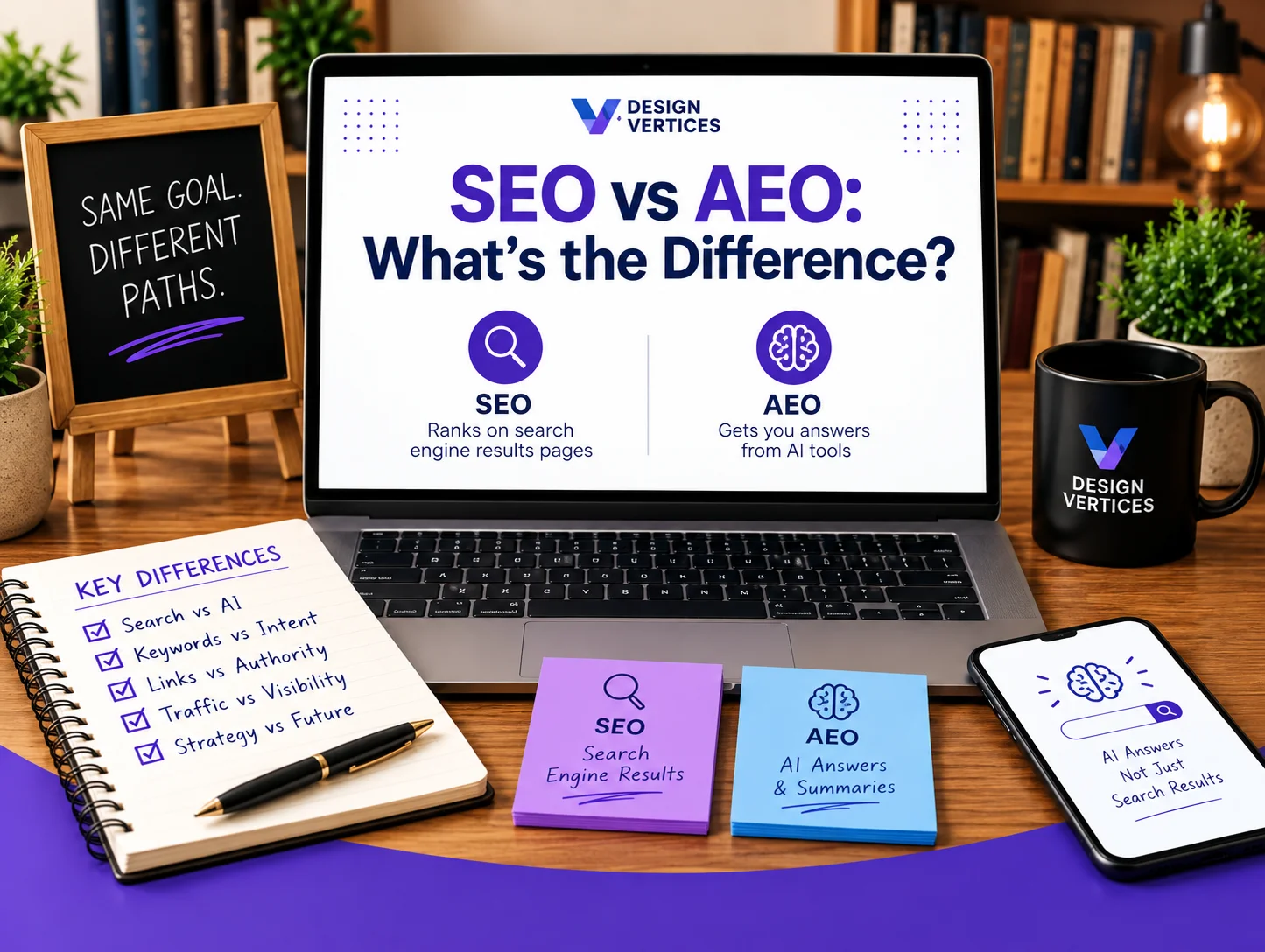
This shift has made SEO vs AEO an important topic for businesses that want to stay visible online. Search engine optimization (SEO) focuses on improving a website’s visibility in search results. Answer engine optimization (AEO) focuses on making content easier for answer engines and AI-powered search experiences to understand, extract, and potentially cite.
The two strategies overlap, but they are not exactly the same.
What Is SEO?
SEO, or search engine optimization, is the process of improving a website so that search engines can discover, understand, index, and rank its content.
Traditional SEO focuses on areas such as:
- Keyword research
- Search intent
- On-page optimization
- Technical SEO
- Internal linking
- Backlinks
- Website structure
- Page experience
- Helpful content
- Local search visibility
The main goal is to increase relevant organic visibility and bring qualified visitors to your website.
If you are new to the subject, our guide explains what is seo and how it works across different parts of a website.
Google’s current Search guidance continues to emphasize helpful, reliable, people-first content, crawlability, internal links, good page experience, and other established SEO fundamentals.
What Is AEO?
AEO stands for Answer Engine Optimization.
It refers to strategies designed to make information easier for answer engines and AI-powered search systems to understand and use when generating answers.
Instead of focusing only on getting a page to rank as a traditional search result, AEO considers how clearly your content answers specific questions and how easily information can be extracted and understood.
Answer engines can include AI-powered experiences such as:
- Google AI Overviews
- Google AI Mode
- ChatGPT
- Perplexity
- Gemini
- Other AI-powered answer systems
For example, someone might search Google for:
“What is technical SEO?”
Another person might ask an AI assistant:
“What are the most important technical SEO factors for a small business website?”
The second query is more conversational and may require the system to synthesize information from multiple sources.
Semrush describes AEO as a strategy focused on visibility in AI-generated answers, while noting that many SEO signals also contribute to AEO visibility.
SEO vs AEO: What Is the Difference?
The simplest way to understand SEO vs AEO is to look at their primary objectives.
SEO focuses on visibility in search results.
AEO focuses on visibility within direct answers and AI-generated responses.
However, the distinction is not absolute.
Google’s own guidance says its AI features are built on Search systems and that existing SEO best practices remain relevant. A page must generally be indexed and eligible to appear in Google Search to be eligible as a supporting link in AI Overviews or AI Mode.
SEO vs AEO at a Glance
| Factor | SEO | AEO |
| Main goal | Improve search visibility | Improve visibility in generated answers |
| Primary experience | Search results pages | AI-generated answers and conversational search |
| User behavior | Search, browse, click | Ask, read, verify, explore |
| Content focus | Search intent and comprehensive content | Direct answers and clear information |
| Important signals | Content, links, technical health, relevance | Clarity, authority, structured information, relevance |
| Common outcomes | Rankings, impressions, clicks, traffic | Mentions, citations, visibility in AI answers |
| Relationship | Foundation | Additional optimization layer |
This comparison is a practical framework rather than a strict separation. Google specifically describes AEO and GEO as terms used for work focused on AI search, while from Google’s perspective, optimizing for generative AI search remains part of SEO.
SEO vs AIO: What’s the Difference?
SEO vs AIO can be confusing because AIO is not used as consistently as SEO or AEO.
In digital marketing discussions, AIO can refer to AI Optimization or broader optimization for AI-powered experiences. The exact meaning depends on the source.
AEO is more specific because it usually refers to Answer Engine Optimization, with a focus on getting information surfaced in direct answers.
A simple way to separate the terms is:
- SEO: Optimize for search engines.
- AEO: Optimize content for answer engines and AI-generated answers.
- AIO: A broader term that may refer to optimizing a brand, content, or digital presence for AI systems.
Because terminology is still evolving, businesses should focus less on the label and more on the actual optimization work being performed.
How SEO and AEO Work Together
SEO and AEO should not normally be treated as competing strategies.
A strong SEO foundation can help make your website discoverable, crawlable, indexable, and understandable. AEO can then focus more closely on how information is structured and presented for question-based and AI-driven search experiences.
Google’s 2026 guidance makes this relationship especially clear. Google says there are no additional technical requirements specifically needed for AI Overviews or AI Mode beyond meeting the normal requirements for Google Search. It also says there is no special schema markup or AI-specific file required to appear in these features.
This means businesses should not abandon SEO simply because AI search is growing.
Instead, the goal should be to create content that works well for both traditional search and newer search experiences.
Why Does AEO Matter?
People increasingly ask longer and more conversational questions.
Instead of searching:
best SEO agency USA
someone may ask:
“What should a small business look for when choosing an SEO agency in the USA?”
AI systems can then synthesize information and provide a direct response.
This changes the way brands can be discovered.
A business may receive visibility when its website is:
- Mentioned in an AI response
- Used as a supporting source
- Linked from an AI-generated answer
- Referenced when a user asks a related question
- Included in a comparison
- Associated with a particular topic or entity
Semrush notes that AEO can involve visibility through AI-generated answers, citations, brand mentions, and other AI search surfaces.
What Are the Main SEO Strategies?
SEO includes several established areas that remain important.
Keyword Research
Keyword research identifies the words and questions people use when searching for information, products, and services.
The goal is not simply to repeat keywords. It is to understand search intent and create content that satisfies what the searcher needs.
Technical SEO
Technical SEO helps search engines access and understand your website.
Important areas include:
- Crawling
- Indexing
- Site architecture
- Page speed
- Mobile usability
- Canonical URLs
- XML sitemaps
- Internal links
- Structured data
On-Page SEO
On-page SEO involves optimizing elements such as:
- Title tags
- Headings
- Content
- URLs
- Images
- Internal links
- Meta descriptions
Off-Page SEO
Off-page SEO includes external signals such as backlinks, brand mentions, digital PR, and other forms of authority building.
Local SEO
Local SEO helps businesses appear when people search for products or services in a specific location.
For businesses serving local customers, a well-planned local seo for small business strategy can improve visibility in relevant local searches.
What Are the Main AEO Strategies?
AEO is still an evolving discipline, but several practical approaches are commonly associated with it.
Answer Questions Directly
Start by answering the question clearly.
Do not make users search through several paragraphs before finding the main answer.
For example:
What is technical SEO?
Start with a short definition, then provide supporting details.
This structure can help both people and automated systems understand the page.
Use Clear Question-Based Headings
Headings can make content easier to scan.
Examples include:
- What is AEO?
- How does AEO work?
- What is the difference between SEO and AEO?
- How do you do AEO?
- Does AEO replace SEO?
Question-based headings also help organize content around natural search behavior.
Provide Complete Context
A short answer alone is not enough for every topic.
Follow the direct answer with supporting information, examples, definitions, data, and relevant context.
This helps create a page that serves users who want both a quick answer and a deeper explanation.
Strengthen Topical Authority
AI systems need reliable information to produce useful answers.
Publishing multiple high-quality resources around a related topic can help establish your website as a relevant source.
This is where a strong SEO content strategy and AEO strategy can overlap.
Use Structured Data Where Appropriate
Structured data can help Google understand eligible content and may support certain search features.
However, Google explicitly says there is no special AEO or AI schema required to appear in AI Overviews or AI Mode. Structured data should therefore be used according to Google’s supported Search features rather than added simply because a page is being optimized for AI.
How to Do AEO
If you want to know how to do AEO, start with the same fundamentals that make content useful for people and search engines.
1. Identify Real Questions
Research the questions your audience asks about your products, services, and industry.
Look at:
- Search queries
- People Also Ask
- Customer questions
- Support conversations
- Forums
- Community discussions
- Related searches
- AI-generated question variations
2. Give the Answer Early
Do not hide the answer at the bottom of the page.
For informational queries, provide a concise answer near the beginning and then expand on it.
3. Organize Content With Clear Headings
Use logical H2s and H3s to divide the topic into clear sections.
Each section should answer a specific question or cover a distinct subtopic.
4. Add Original Information
Do more than repeat what other websites already say.
Add:
- Original research
- First-hand experience
- Examples
- Expert commentary
- Data
- Comparisons
- Case studies
Google’s current guidance emphasizes unique, valuable, non-commodity content for both traditional and generative search experiences.
5. Build Trust and Authority
AI systems need reliable information to produce useful answers.
Support important claims with credible sources and demonstrate expertise where appropriate.
6. Keep Content Updated
Outdated information can reduce the usefulness of a page.
Review important content regularly, particularly when discussing:
- Prices
- Software
- Regulations
- Products
- Statistics
- Industry trends
- Search algorithms
7. Make Your Website Easy to Crawl
A page cannot be useful in search if search engines cannot properly access or index it.
Check:
- Robots.txt
- Indexing
- Internal links
- Canonical tags
- Site architecture
- JavaScript rendering
- Page accessibility
Google states that pages need to be indexed and eligible to appear in Search to be eligible as supporting links in AI Overviews or AI Mode.
Does AEO Replace SEO?
No. AEO does not replace SEO.
Google’s current documentation explicitly states that existing SEO best practices remain relevant to generative AI features in Search. Its AI systems use information from Google’s Search index, meaning crawlability, indexing, technical quality, and helpful content remain important.
Optimizely and Semrush similarly frame AEO as an extension or complementary layer rather than a complete replacement for SEO.
A practical strategy is therefore:
SEO → Make your website discoverable and useful.
AEO → Make your information clear, direct, structured, and useful for answer-based search experiences.
Should You Focus on SEO or AEO?
For most businesses, the choice does not have to be either/or.
SEO remains important for:
- Organic search rankings
- Website traffic
- Local visibility
- Technical performance
- Content discovery
- Search demand
AEO can add value when you want your brand and information to appear in:
- AI-generated answers
- Conversational search
- AI Overviews
- AI Mode
- Other answer-based experiences
The strongest approach is usually to build a solid SEO foundation and then make the content easy for both people and modern search systems to understand.
How Do You Measure SEO and AEO?
SEO and AEO require different types of measurement.
SEO Metrics
Common SEO metrics include:
- Organic impressions
- Organic clicks
- Keyword rankings
- Organic traffic
- Click-through rate
- Conversions
- Backlinks
- Indexed pages
AEO Metrics
AEO measurement can include:
- AI mentions
- Brand citations
- AI visibility
- Frequency of inclusion in AI answers
- Referral traffic from AI platforms
- Conversions from AI referrals
- Share of visibility against competitors
Google has also introduced Search Console reporting for visibility in generative AI features, including AI Overviews and AI Mode. As of August 31, 2026, Google says these insights have rolled out to websites worldwide.
SEO vs AEO for Local Businesses
Local businesses should not abandon local SEO while exploring AEO.
Your Google Business Profile, location information, website content, reviews, local citations, and consistent business details can all remain important parts of your search presence.
For example, a person might search:
“dentist near me”
while another might ask:
“What are the best options for a family dentist in Austin that accepts new patients?”
The search behavior is different, but the business still needs accurate, useful, trustworthy information online.
A strong local search foundation can therefore support visibility across changing search experiences.
SEO vs AEO for SaaS Companies
SaaS companies can benefit from combining traditional SEO with answer-focused content.
For example, a SaaS company can create content around:
- Product comparisons
- How-to guides
- Feature explanations
- Industry questions
- Pricing questions
- Integration guides
- Troubleshooting
- Use cases
- Alternatives
- Buyer comparisons
A well-planned seo for saas companies strategy can attract users through traditional search while clear, question-focused content can make important information easier to understand across AI search experiences.
How Design Vertices Can Help
Businesses need a strong SEO foundation before adding new search strategies.
Our seo services in the USA can help businesses improve technical SEO, content, keyword targeting, site structure, and organic visibility.
The process can start with understanding what is seo, evaluating your current website, and identifying technical and content gaps.
An seo audit checklist can help uncover issues with indexing, internal links, page structure, technical performance, and on-page optimization.
If you are comparing investment levels, understanding seo cost in the us can also help you plan a realistic search marketing budget.
The goal is not to chase every new acronym in search marketing. It is to build a website that is technically sound, useful to users, easy to understand, and ready for how people search today.
SEO vs AEO: Key Takeaways
The key points are simple:
- SEO focuses on improving visibility in search engines.
- AEO focuses on visibility in direct and AI-generated answers.
- SEO and AEO overlap significantly.
- AEO does not replace traditional SEO.
- Google says its AI Search experiences continue to rely on foundational SEO.
- There is no special AI markup required for Google AI Overviews or AI Mode.
- Clear, useful, original content matters for both.
- Technical SEO remains important because AI search relies on accessible and indexed content.
- Businesses should measure both traditional search visibility and AI visibility where relevant.
The future of search is not necessarily SEO vs AEO. It is a broader search environment where traditional results, AI-generated answers, conversational queries, and other discovery formats work alongside each other.
Businesses that focus on useful content, strong technical foundations, clear information, and real authority can build visibility across these changing search experiences.
