.png)
Your website is often the first impression potential customers have of your business. It serves as your digital storefront, sales representative, and credibility builder all at the same time.
But unlike a physical office, a website can become outdated much faster. Design trends change, technology evolves, customer expectations shift, and search engines continue updating their ranking factors.
This raises an important question: How often should you redesign your website?
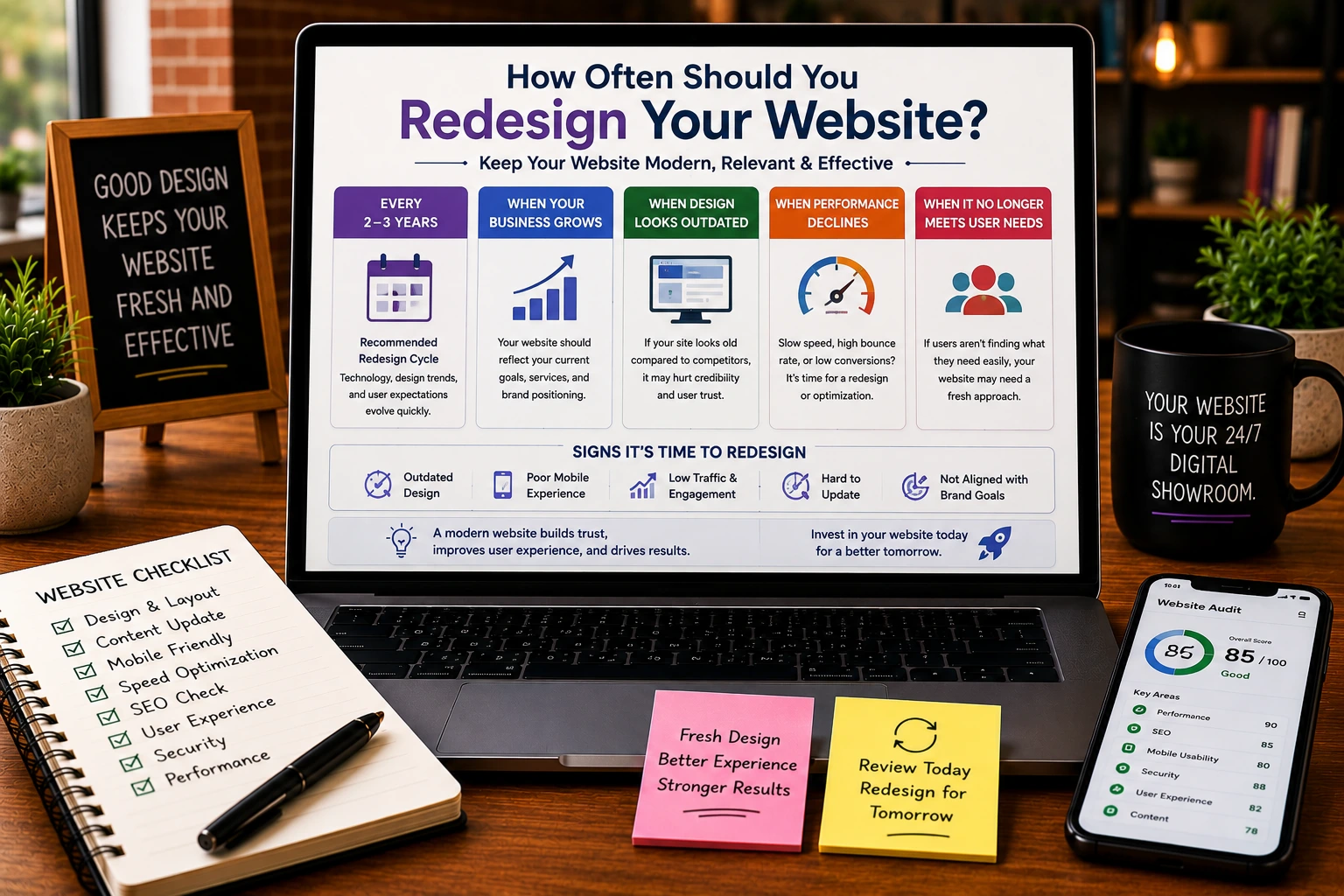
The short answer is that most businesses should consider a website redesign every 2 to 3 years, with ongoing updates and improvements made throughout the website’s lifecycle.
However, the ideal timeline depends on your industry, goals, performance metrics, and how well your current website is meeting user expectations.
In this guide, we’ll explore when a redesign makes sense, warning signs that your website may be holding your business back, and how to determine whether it’s time for a complete overhaul or simply a refresh.
Quick Answer: How Often Should You Redesign Your Website?
Recommended Website Redesign Timeline
| Business Type | Recommended Redesign Cycle |
| Small Businesses | Every 2–3 Years |
| Ecommerce Stores | Every 2–3 Years |
| SaaS Companies | Every 1–2 Years |
| Professional Services | Every 2–4 Years |
| Enterprise Websites | Continuous Optimization + Major Redesign Every 3–5 Years |
While there is no universal rule, most modern websites require significant updates within a few years to remain competitive.
Why Websites Become Outdated
A website does not need to be broken to become ineffective.
Many websites gradually lose performance because:
- User expectations change
- Design trends evolve
- Technology advances
- Search engine requirements change
- Competitors improve their websites
A site that looked modern five years ago may now appear outdated and less trustworthy.
The Cost of Keeping an Outdated Website
Many businesses delay redesigns because their website is still functioning.
The problem is that an outdated website often impacts:
User Experience
Visitors may struggle to find information or complete desired actions.
Conversion Rates
Poor design can reduce inquiries, bookings, and sales.
Search Visibility
Older websites often have technical SEO issues that limit rankings.
Brand Perception
Users often judge credibility based on website quality.
A dated website can make a successful business appear less professional than competitors.
7 Signs It’s Time to Redesign Your Website
1. Your Website Looks Outdated
First impressions matter.
If your website feels old compared to competitors, visitors may question the quality of your products or services.
Signs include:
- Outdated layouts
- Old-fashioned typography
- Poor imagery
- Inconsistent branding
Modern websites prioritize clean design, simplicity, and usability.
2. Your Site Isn’t Mobile Friendly
Today, most website traffic comes from mobile devices.
If users struggle to navigate your website on smartphones or tablets, you are likely losing opportunities.
Modern businesses should prioritize mobile-first design because Google primarily evaluates websites through mobile-first indexing.
Common Mobile Problems
- Tiny text
- Poor navigation
- Slow loading pages
- Broken layouts
- Difficult forms
3. Your Website Loads Slowly
Website speed directly affects:
- User experience
- Bounce rates
- SEO performance
- Conversion rates
Visitors expect websites to load quickly.
If your pages are slow, users may leave before engaging with your content.
Warning Signs
- High bounce rates
- Slow page speeds
- Poor Core Web Vitals scores
Performance improvements are often a major reason businesses redesign their websites.
4. Your Conversion Rates Are Declining
A website should support business growth.
If traffic remains stable but conversions decline, your website may no longer meet user expectations.
Common indicators include:
- Fewer leads
- Lower form submissions
- Reduced sales
- Decreased engagement
A redesign often improves conversion paths and user journeys.
5. Your Branding Has Changed
Businesses evolve over time.
If your:
- Logo
- Messaging
- Visual identity
- Service offerings
have changed significantly, your website should reflect those updates.
Your website should accurately represent your current brand.
6. SEO Performance Has Stalled
Search engines continue evolving.
Older websites often suffer from:
- Technical SEO issues
- Poor site architecture
- Weak internal linking
- Slow page speeds
These issues can limit organic visibility.
Many businesses begin researching 5 signs your business needs a website redesign after noticing traffic declines or stagnant rankings.
7. Managing Content Has Become Difficult
If updating content requires excessive time or technical expertise, your website may be built on outdated technology.
Modern content management systems allow businesses to:
- Publish content easily
- Update pages quickly
- Scale efficiently
A redesign can simplify ongoing website management.
Website Refresh vs Website Redesign
Not every website issue requires a complete rebuild.
Understanding the difference can save time and money.
Website Refresh
A refresh typically includes:
- Updated visuals
- New images
- Revised content
- Minor UX improvements
Best For
- Modern websites with minor issues
- Branding updates
- Small usability improvements
Website Redesign
A redesign often involves:
- New structure
- New layouts
- Technical improvements
- SEO optimization
- Enhanced functionality
Best For
- Outdated websites
- Performance issues
- Rebranding initiatives
- Significant growth goals
What Happens During a Website Redesign?
A successful redesign involves more than changing colors and layouts.
Step 1: Discovery and Research
Analyze:
- Business goals
- Audience needs
- Competitor websites
- Existing performance data
Step 2: User Experience Planning
Create:
- Wireframes
- Navigation structures
- User journeys
Step 3: Visual Design
Develop:
- Brand-consistent layouts
- Mobile-responsive designs
- Modern interfaces
Step 4: Development
Build:
- Responsive pages
- Fast-loading assets
- SEO-friendly architecture
Step 5: Testing and Launch
Review:
- Functionality
- Speed
- Mobile usability
- SEO performance
How Website Redesigns Improve SEO
Many redesign projects create significant SEO opportunities.
Benefits often include:
- Improved site speed
- Better Core Web Vitals
- Enhanced mobile usability
- Improved internal linking
- Better content structure
However, redesigns should be planned carefully to avoid losing existing rankings.
Proper redirects and SEO preservation strategies are critical.
Should You Hire a Professional Agency?
Website redesigns involve multiple disciplines:
- Strategy
- User experience
- Design
- Development
- SEO
- Conversion optimization
Many businesses find that hiring a web design agency provides access to specialized expertise that improves both user experience and long-term website performance.
Professional agencies help ensure the redesign supports business goals rather than simply changing aesthetics.
How Design Vertices Approaches Website Redesigns
At Design Vertices, website redesign projects focus on more than visual improvements.
Our team evaluates:
- User experience
- Mobile performance
- Technical SEO
- Conversion opportunities
- Site architecture
- Brand positioning
The goal is to create websites that not only look modern but also support lead generation, visibility, and business growth.
Final Thoughts
So, how often should you redesign your website?
For most businesses, a major redesign every 2 to 3 years is a practical guideline, with ongoing improvements made between redesign cycles.
Rather than waiting until a website feels completely outdated, businesses should regularly evaluate performance, usability, branding, and customer expectations.
A modern, fast, and user-friendly website can improve credibility, support SEO efforts, and help generate more leads and sales over the long term.
FAQs
How often should you redesign your website?
Most businesses should consider redesigning their website every 2 to 3 years, depending on performance and industry changes.
How do I know if my website needs a redesign?
Signs include outdated design, poor mobile usability, slow loading speeds, declining conversions, and SEO challenges.
Can a website redesign improve SEO?
Yes. A properly executed redesign can improve site speed, user experience, technical SEO, and overall search visibility.
What’s the difference between a website refresh and a redesign?
A refresh updates visual elements, while a redesign typically involves structural, technical, and user experience improvements.
Is mobile responsiveness important for modern websites?
Absolutely. Mobile-first design is essential for user experience, search visibility, and conversion performance.
Should I hire a web design agency for a redesign?
Many businesses benefit from professional expertise in strategy, design, development, SEO, and conversion optimization during a redesign project.
