.png)
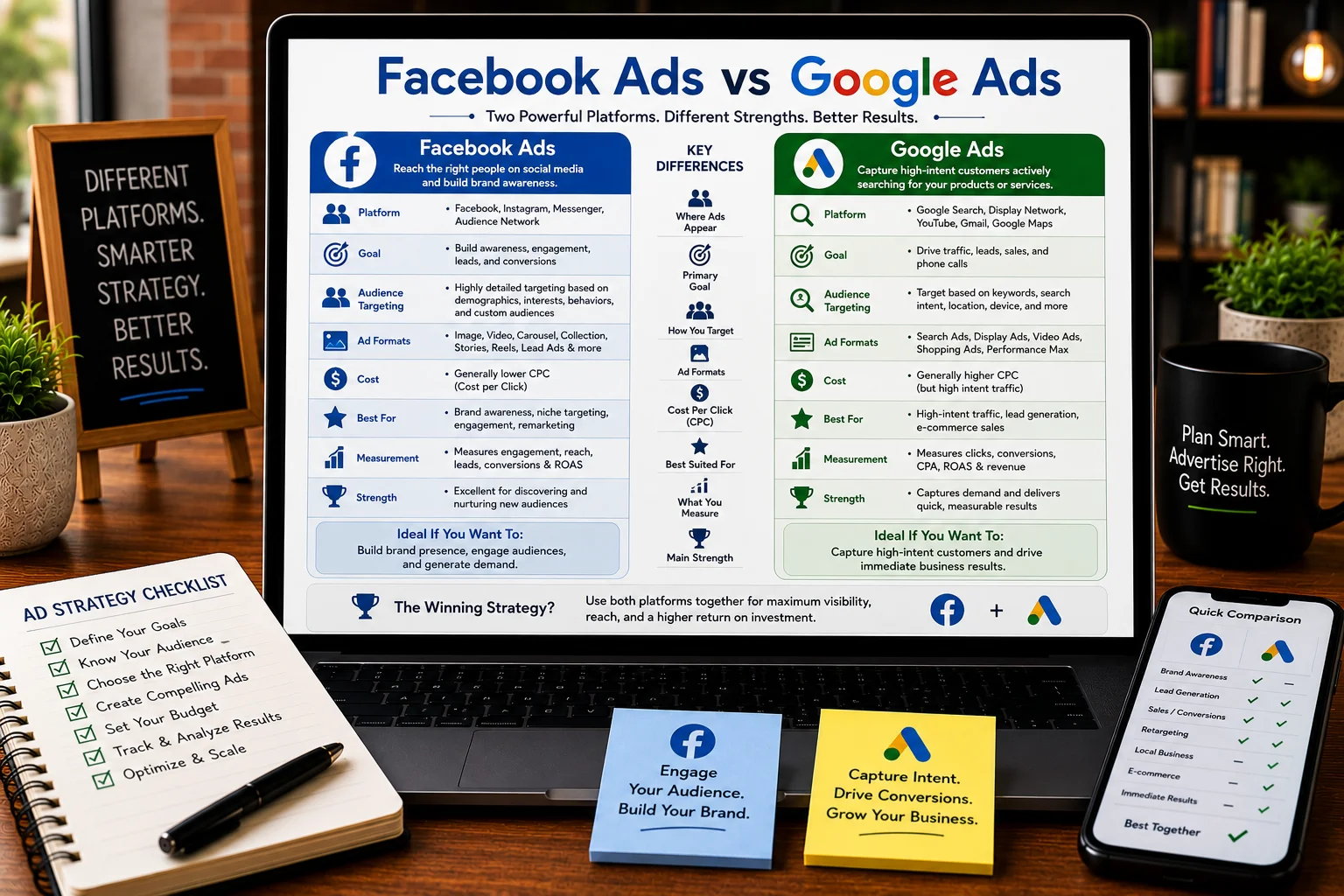
Businesses looking to generate more leads, increase sales, and grow brand awareness often find themselves comparing two of the largest advertising platforms in the world: Facebook Ads and Google Ads.
Both platforms offer powerful targeting capabilities and massive audiences, but they work in very different ways.
Google Ads helps businesses reach users actively searching for products or services, while Facebook Ads focuses on targeting people based on demographics, interests, behaviors, and online activity.
This creates an important question: Facebook Ads vs Google Ads — which platform delivers better results? The answer depends on your goals, budget, industry, audience, and customer journey. In this guide, we’ll compare both advertising platforms across cost, targeting, performance, lead generation, and return on investment to help businesses make informed marketing decisions.
Facebook Ads vs Google Ads: Quick Comparison
| Factor | Facebook Ads | Google Ads |
| Audience Intent | Passive discovery | Active search intent |
| Cost Per Click | Generally lower | Often higher |
| Lead Generation | Excellent for awareness | Excellent for high-intent leads |
| Brand Awareness | Strong | Moderate |
| Purchase Intent | Lower | Higher |
| Audience Targeting | Advanced interest targeting | Keyword targeting |
| Speed of Results | Immediate | Immediate |
| Best For | Awareness & engagement | Demand capture & conversions |
Both platforms can be highly effective when used correctly.
What Are Facebook Ads?
Facebook Ads are paid advertisements that appear across:
- Messenger
- Audience Network
Rather than targeting search behavior, Facebook focuses on audience characteristics.
Businesses can target users based on:
- Age
- Gender
- Location
- Interests
- Behaviors
- Life events
- Previous interactions
This makes Facebook particularly effective for introducing products and services to potential customers before they actively begin searching.
What Are Google Ads?
Google Ads allows businesses to display advertisements across:
- Google Search
- Google Display Network
- YouTube
- Google Shopping
- Partner websites
Google Ads primarily targets users based on search intent.
For example:
A person searching:
“best SEO company near me”
already has a need and is actively looking for a solution.
This intent-driven approach often produces highly qualified leads.
The Biggest Difference: Intent vs Discovery
The most important distinction between Facebook Ads and Google Ads is user intent.
Google Ads Captures Existing Demand
Users are actively searching for:
- Products
- Services
- Solutions
- Information
They already know they need something.
Facebook Ads Creates Demand
Users are browsing social media.
They may not be actively searching for a solution.
Instead, businesses introduce products and services through highly targeted campaigns.
This difference impacts every aspect of campaign performance.
Facebook Ads vs Google Ads Cost
One of the most common questions businesses ask is about pricing.
Average Cost Comparison
| Metric | Facebook Ads | Google Ads |
| Average CPC | Lower | Higher |
| Average CPM | Lower | Higher |
| Competitive Industry Costs | Moderate | Often Very High |
| Budget Flexibility | High | High |
In many industries, Facebook ads vs google ads cost comparisons show Facebook generating lower cost-per-click figures.
However, lower click costs do not always translate into better overall ROI.
The quality of leads often matters more than the cost of traffic.
Facebook Ads vs Google Ads Performance
When evaluating Facebook Ads vs Google Ads Performance, businesses should focus on outcomes rather than vanity metrics.
Facebook Ads Often Excel At
- Brand awareness
- Audience growth
- Retargeting
- Video engagement
- Product discovery
Google Ads Often Excel At
- Lead generation
- Sales inquiries
- Service-based businesses
- Local search visibility
- High-intent conversions
Performance depends heavily on campaign objectives.
Audience Targeting Comparison
Facebook Ads Targeting
Facebook’s audience targeting remains one of its strongest advantages.
Businesses can target users based on:
- Interests
- Hobbies
- Purchase behavior
- Demographics
- Relationship status
- Job titles
This allows advertisers to build highly specific audience segments.
Google Ads Targeting
Google primarily targets users through:
- Keywords
- Search intent
- Geographic location
- Device type
- Audience signals
Rather than targeting who people are, Google often targets what people are searching for.
Which Platform Generates Better Leads?
Lead quality often differs between platforms.
Google Ads Leads
Users are actively looking for solutions.
This often results in:
- Higher conversion intent
- Faster buying decisions
- Better lead quality
Facebook Ads Leads
Users may not be actively searching.
This often results in:
- Larger audiences
- Lower lead costs
- Longer sales cycles
For businesses focused on immediate inquiries, Google Ads often performs better.
For awareness and audience building, Facebook frequently excels.
Ecommerce: Facebook Ads vs Google Ads
Ecommerce businesses often use both platforms.
Facebook Ads Benefits
- Product discovery
- Retargeting
- Visual storytelling
- Impulse purchases
Google Ads Benefits
- Shopping campaigns
- Product searches
- High purchase intent
- Comparison shoppers
Many ecommerce brands see the strongest results when combining both platforms.
Local Businesses: Which Platform Works Better?
Local businesses often ask whether they should advertise on Facebook or Google.
Google Ads
Best for:
- Emergency services
- Contractors
- Lawyers
- Dentists
- Service providers
Users actively search when they need help.
Facebook Ads
Best for:
- Local promotions
- Events
- Restaurants
- Gyms
- Retail businesses
Facebook helps businesses stay visible within their communities.
Which Platform Delivers Better ROI?
The answer depends on your goals.
Choose Facebook Ads If You Want
- Brand awareness
- Audience growth
- Lower traffic costs
- Product discovery
- Community engagement
Choose Google Ads If You Want
- Immediate leads
- Service inquiries
- Purchase-ready traffic
- High-intent searches
- Faster conversions
Why Many Businesses Use Both
The highest-performing marketing strategies rarely rely on a single advertising platform.
Instead:
Facebook Builds Awareness
Potential customers discover your brand.
Google Captures Intent
Those same users later search and convert.
This creates a powerful full-funnel marketing strategy.
The Role of Landing Pages in Ad Performance
Regardless of platform, your landing page significantly impacts results.
Poor website experiences often reduce:
- Conversion rates
- Lead quality
- Advertising ROI
Businesses experiencing low ad performance may discover that 5 signs your business needs a website redesign are already affecting their campaigns.
Improving website usability often produces better advertising outcomes.
Mobile Experience Matters More Than Ever
Today, most ad traffic comes from smartphones.
Whether traffic originates from Facebook or Google, businesses should prioritize mobile-first design to ensure visitors have a fast and user-friendly experience.
A poor mobile experience can waste advertising spend and reduce conversions.
Should You Hire Professionals to Manage Advertising Campaigns?
Successful advertising requires:
- Audience research
- Campaign setup
- Landing page optimization
- Budget management
- Performance analysis
Many businesses partner with agencies that specialize in digital marketing, website optimization, and advertising strategy.
For organizations already considering hiring a web design agency, it is often beneficial to choose a team that understands both website performance and lead generation.
How Design Vertices Helps Businesses Generate More Leads
At Design Vertices, we help businesses create integrated marketing strategies that align advertising, website performance, and conversion optimization.
Our team supports:
- Facebook advertising
- Google Ads campaigns
- Landing page optimization
- Website design improvements
- Conversion rate optimization
- Lead generation strategies
By combining strong advertising campaigns with high-performing websites, businesses can improve both traffic quality and conversion rates.
Final Thoughts
The debate around Facebook Ads vs Google Ads is not about finding a universal winner.
Each platform serves a different purpose.
Google Ads captures people who are actively searching for solutions. Facebook Ads helps businesses reach highly targeted audiences before they begin searching.
For lead generation and high-intent traffic, Google Ads often performs better.
For awareness, engagement, and audience growth, Facebook Ads frequently delivers exceptional results.
The most successful businesses often use both platforms together, creating a marketing system that generates awareness, captures demand, and drives long-term growth.
FAQs
Which is better: Facebook Ads or Google Ads?
It depends on your goals. Google Ads is often better for lead generation, while Facebook Ads excels at awareness and audience targeting.
Are Facebook Ads cheaper than Google Ads?
In many industries, Facebook Ads have lower average cost-per-click rates than Google Ads.
Which platform provides better leads?
Google Ads often generates higher-intent leads because users are actively searching for products or services.
Can small businesses use both Facebook Ads and Google Ads?
Yes. Many small businesses use both platforms to create awareness and generate conversions.
Which platform is best for ecommerce?
Many ecommerce businesses achieve the best results by combining Facebook Ads and Google Shopping campaigns.
Does website quality affect ad performance?
Absolutely. Landing page quality, mobile responsiveness, and user experience significantly impact advertising ROI.
